Orb - On the Movements of the Earth: Review
To all the skeptics who thought that 100 meters might've been a fluke, Uoto unleashes a metaphorical »hold my pen« and shows them the world doesn't revolve around them. With his subsequent manga monolith towering over every other thought-provoking manga over the last few years, he's become one of the best manga authors of recent times. And if you disagree, then that's fine, as long as you keep thinking!
Orb: On the Movements of the Earth is a 2024 25-episode anime television series directed by Kenichi Shimizu, based on a 2020 historical sci-fi manga by the Japanese manga artist Uoto. The manga was serialized from 2020 to 2022 in the seinen manga magazine Weekly Big Comic Spirits. In Japan, the term seinen refers to an editorial category of Japanese comics marketed toward adult men, while the term josei applies to those marketed towards adult women. With Orb, Uoto finally reached critical success, surpassing the accolades received for 100 Meters, his final “one-shot manga”. The author has received praise for his thought-provoking and intricate storytelling, but that is no news to anyone who’s familiar with his material. Both of the aforementioned works received complete anime adaptations in 2025 and I urge anyone who hasn’t been exposed to either to stop reading and watch them for themselves (also feel free to check out my review for 100 meters, thanks!). With all that said, let's dive in!
Unlike conventional anime plots, we do not follow merely one protagonist throughout the story. Instead, the story is split into smaller arcs, each focusing on different characters and their point of view: Rafal, Oczy, Badeni, Yolanda and Draka. There are also un-telegraphed time-skips in-between most arcs, so the party of characters we follow constantly changes. Nevertheless, the synopsis boils down to this: The story is set in 15th-century Europe (the names of characters inconclusively hint at Poland) and we follow the adventures of multiple scholars that research heliocentrism. It is the time of ecclesiastical polity, inquisitions and geocentrism – an idea that Earth is the stationary center of the universe, with all celestial bodies orbiting it. The Church’s doctrine is absolute and all information is controlled, our protagonists risk their lives to pursue opposing theories, as anyone that publicly opposed the Church was branded a heretic and sentenced to death. The story starts with Rafal, a child genius who loves astronomy. Despite his true passion, he is urged to study theology by his adopted single father Potocki, who warns him to stop pursuing astronomy, as people are branded heretics for opposing Church’s beliefs and burnt at the stake daily. Potocki does, however, task Rafal with picking up an acquaintance known as Hubert, a recanted heretic, who will live with them for the time being. Rafal’s life changes the moment he starts discussing astronomy with Hubert, who defends heliocentrism and challenges Rafal’s beliefs. Rafal confirms the model through his own calculations, but foolishly leaves them unhidden at home. They are later discovered by a cruel inquisitor, Nowak, which forces Hubert to take the blame upon himself to save Rafal and get executed. Rafal is forced to choose: recant and live what you believe is a lie or refuse & risk dying for your truth.
As this show is extremely atypical, it is almost impossible to describe it through main characters alone, so I won’t even attempt to do so. For such a short and condensed series, Orb succeeds in many things: Since our fellowship cast changes every few episodes, it makes for a most gripping overarching story and the achieved suspense never feels reliant on flashy animated action or shoe-horned character twists. However, there are plenty of physical brawls and painful sounding scenes of inquisitors torturing suspects, which might be too much for some eyes. Still, while this show is mostly dialogue-heavy, the character interactions never feel drawn-out or forced. In fact, the spacious discourses and the abundance of time for fleshing out the character’s opinions are imperative to successfully explore the concepts of truth and religion, and Orb excels in that beautifully. The anime doesn’t offer definitive answers on God and faith, in lieu it pushes for the notion that it’s about the journey of questioning itself and continuing to think and shape our own perspective. It is extremely rare for an author to incorporate a wide spectrum of valid beliefs, since, typically, an author picks one and then spreads their one agenda throughout the entire cast, each showcasing a different side of the same ideology, sprinkled with symbols. Instead, the author rejects polarization and forces the characters to also interact and cooperate with people that only partially share core beliefs. My favorite example is the scene where Draka, a Romani child, discusses religion with Schmidt, the captain of the Heretic Liberation Front; Both oppose the Church and the Bible, yet one comes out as an atheist and the other a pantheist, and they end up both accepting the differences to fight the cast system together.
Spoiler: It is worth mentioning that the final episode has an ambiguous ending. At first, it offers insight on the ambivalence of extremism (we see an alternate and ambiguous end of what would happen to Rafal if he were willing to also sacrifice others for his beliefs) and how it shouldn’t be ignored. But then we learn that despite the entire main cast having passed away and no physical trace of them remaining, their idea eventually reaches and inspires Copernicus, giving the entire adventure an extra meaning. From the very beginning, the show drives and sticks to the notion that an idea is more important than a single person. After all, there’s only two ties that bind the main cast together – one is carrying on the inspiration for heliocentrism to survive and become a legitimate scientific theory, the other is standing up for your beliefs, even at the cost of their lives.
Besides the notion of the idea mattering more than individuals, Uoto reasserts the necessity of critical thinking In each arc and how vital it is to allow others to keep thinking for themselves, even if they disagree with us. All of this brings us to the final message of this show and one I also agree with: All of us are flawed and we all lack answers, that’s why we have to keep looking for answers or a higher purpose and, in due process, have to support each other. Gatekeeping knowledge and uprooting free speech indirectly inhibits our own and - by extension - humanity’s progress. But if, instead, we help each other and let our ideas prosper, then - much like Rafal and the rest of the cast - we can truly move the Earth together.
Rating: 9/10
- Philip
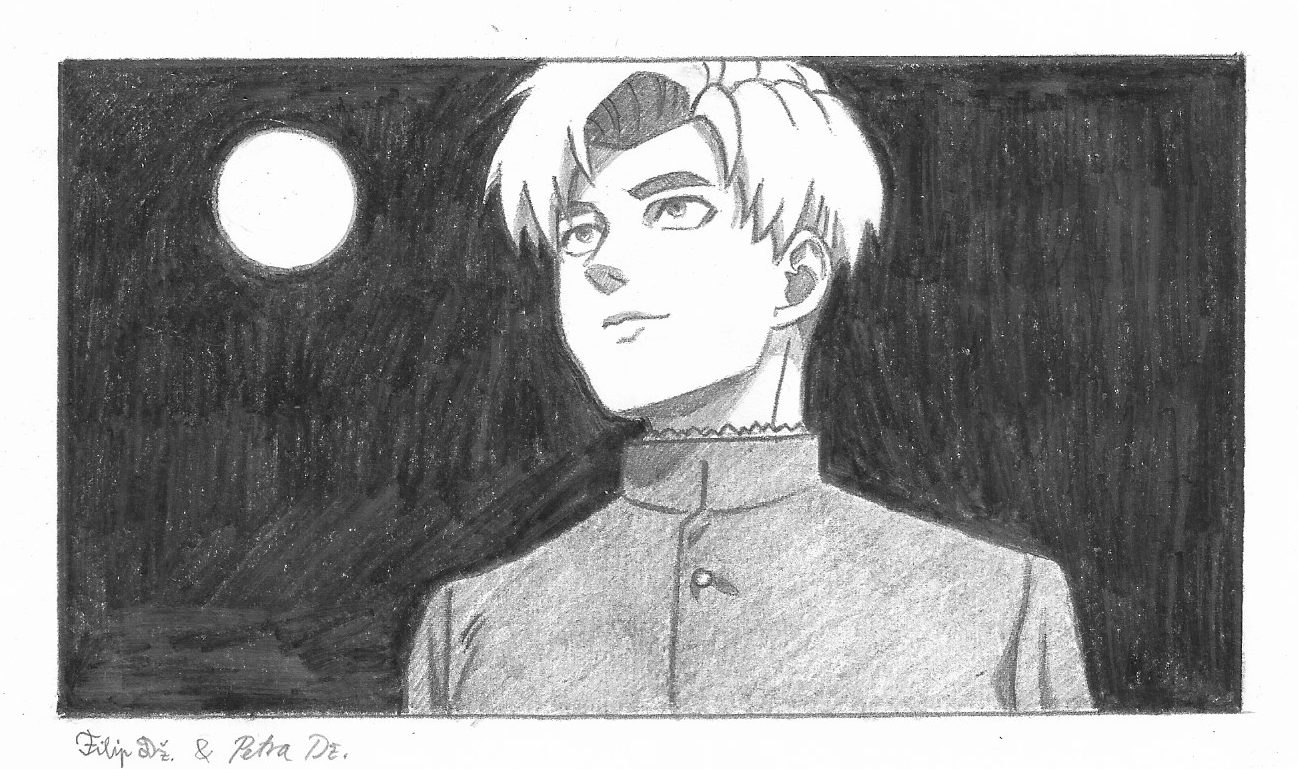
Original illustration: Rafal
